
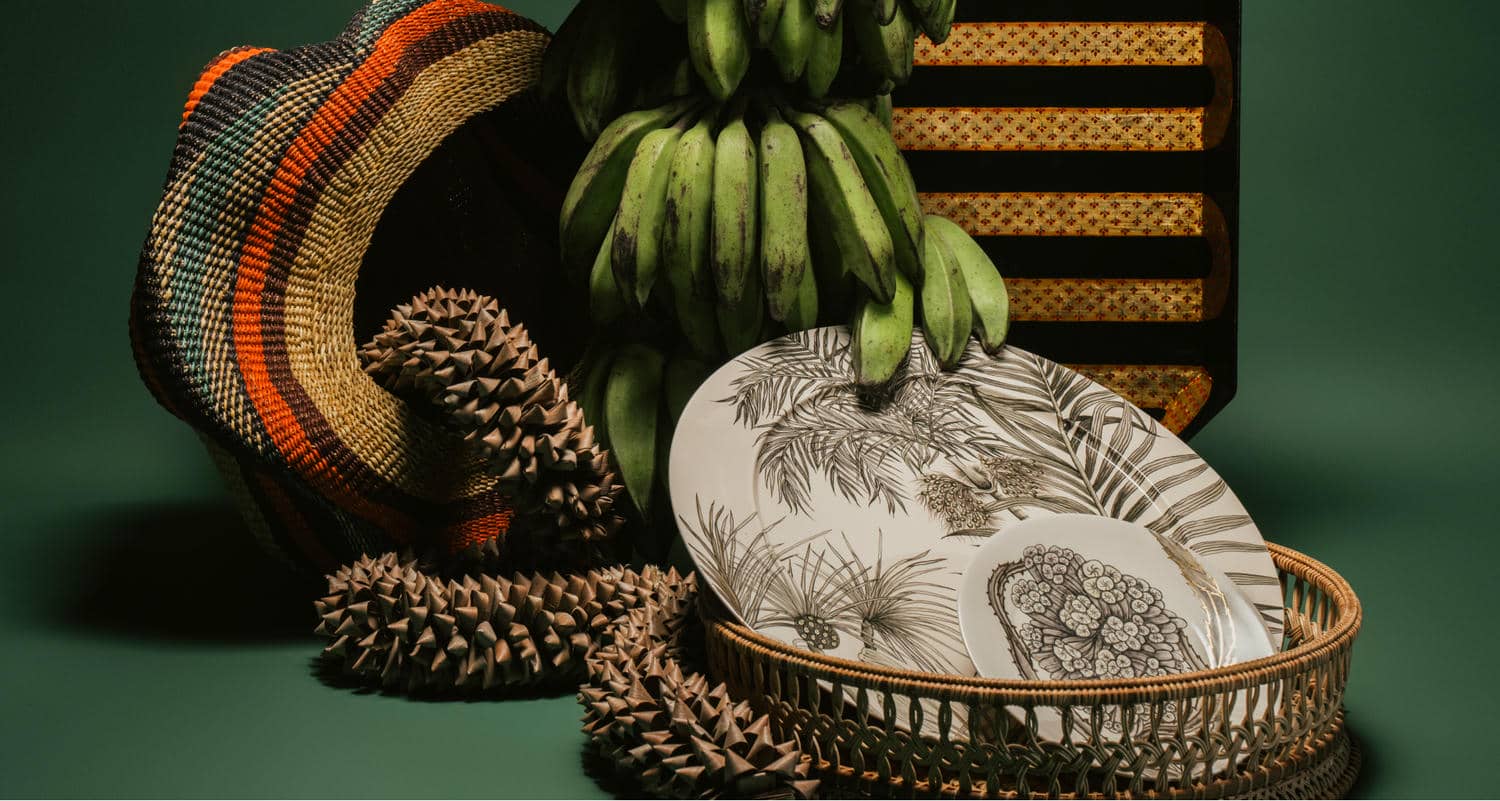
Handpainted tableware brand Khanoom’s collections with Nilaya Anthology showcase two remarkable historical moments that centred India within global design conversations.
Before it is a plate, it is a riverbed. Before it is a vessel, it is silt; pressed by time, lifted by hand, steadied on a wheel. Clay remembers what paper forgets. It holds the impression of fingers, the hesitation of touch, the temperature of fire. Across centuries, across continents, it has been the most faithful witness to how we have lived: how we gathered, how we ate, how we marked the sacred. The ceramic vessel is not merely a functional object but a site of historical narrative and material convergence. In a courtyard in Jaipur, once occupied by glass furnaces, Khanoom by Priyamvada Golcha and Simon Marks works with this same material memory, shaping earth into tableware that carries both archive and appetite.
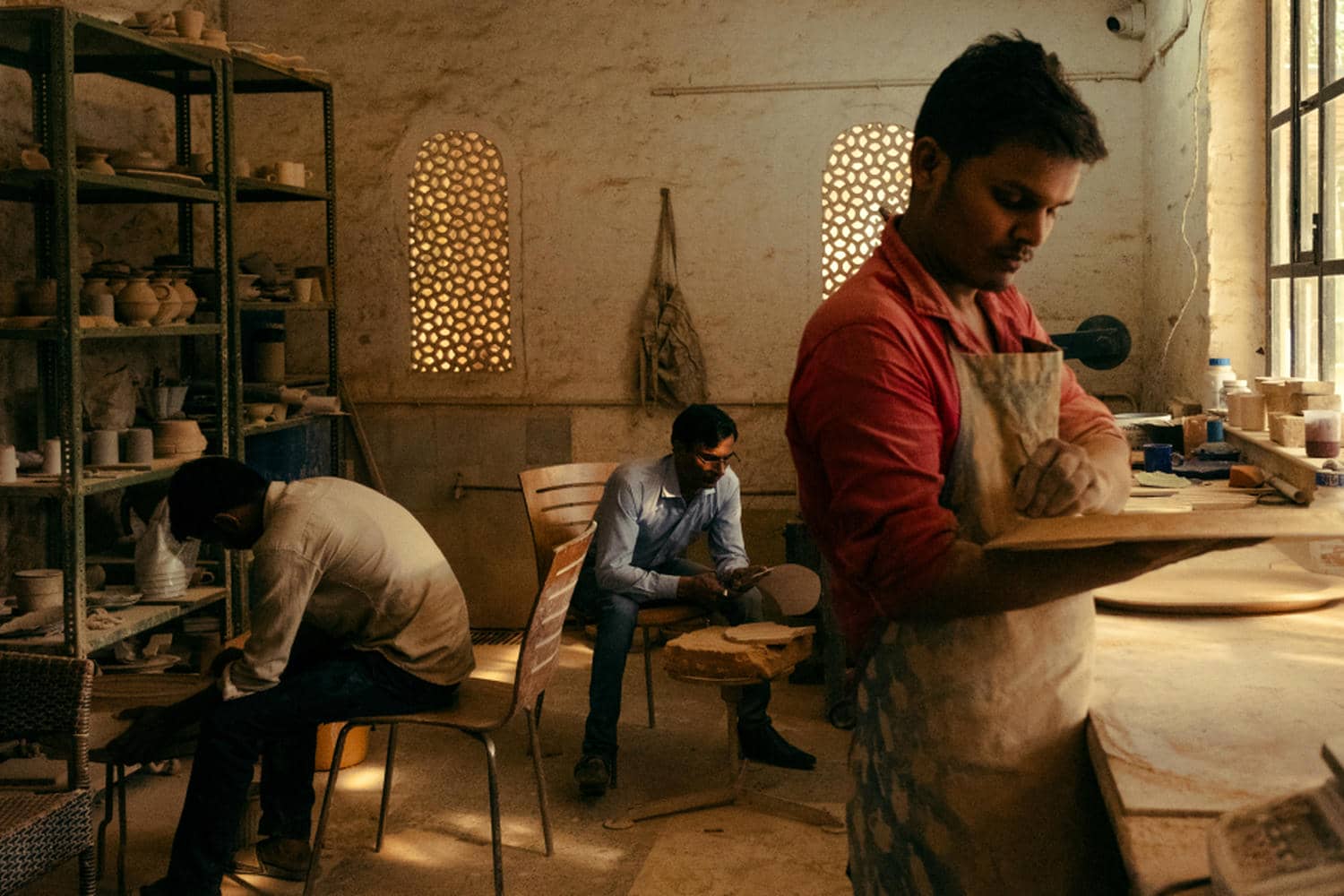
The name is an invocation of Khnum, the ram-headed Egyptian deity believed to have fashioned human beings from the silt of the Nile on a potter’s wheel. This reference is not merely ornamental; it establishes a foundational philosophy that views the maker as a central repository of knowledge and continuity. In the Khanoom workshop, human skill is treated as
an alchemical process where earth, water, and fire are transformed into objects of uncommon beauty.
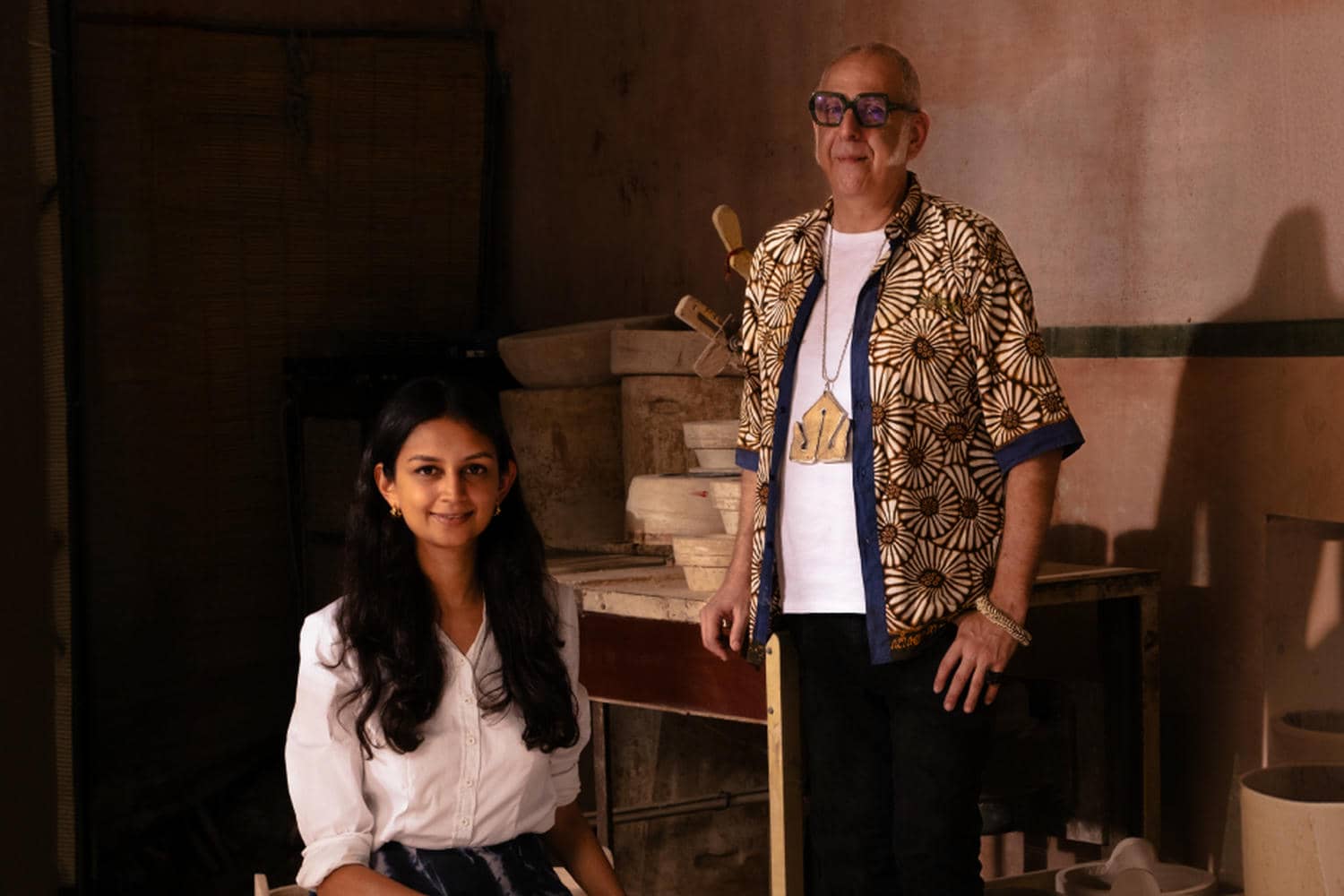
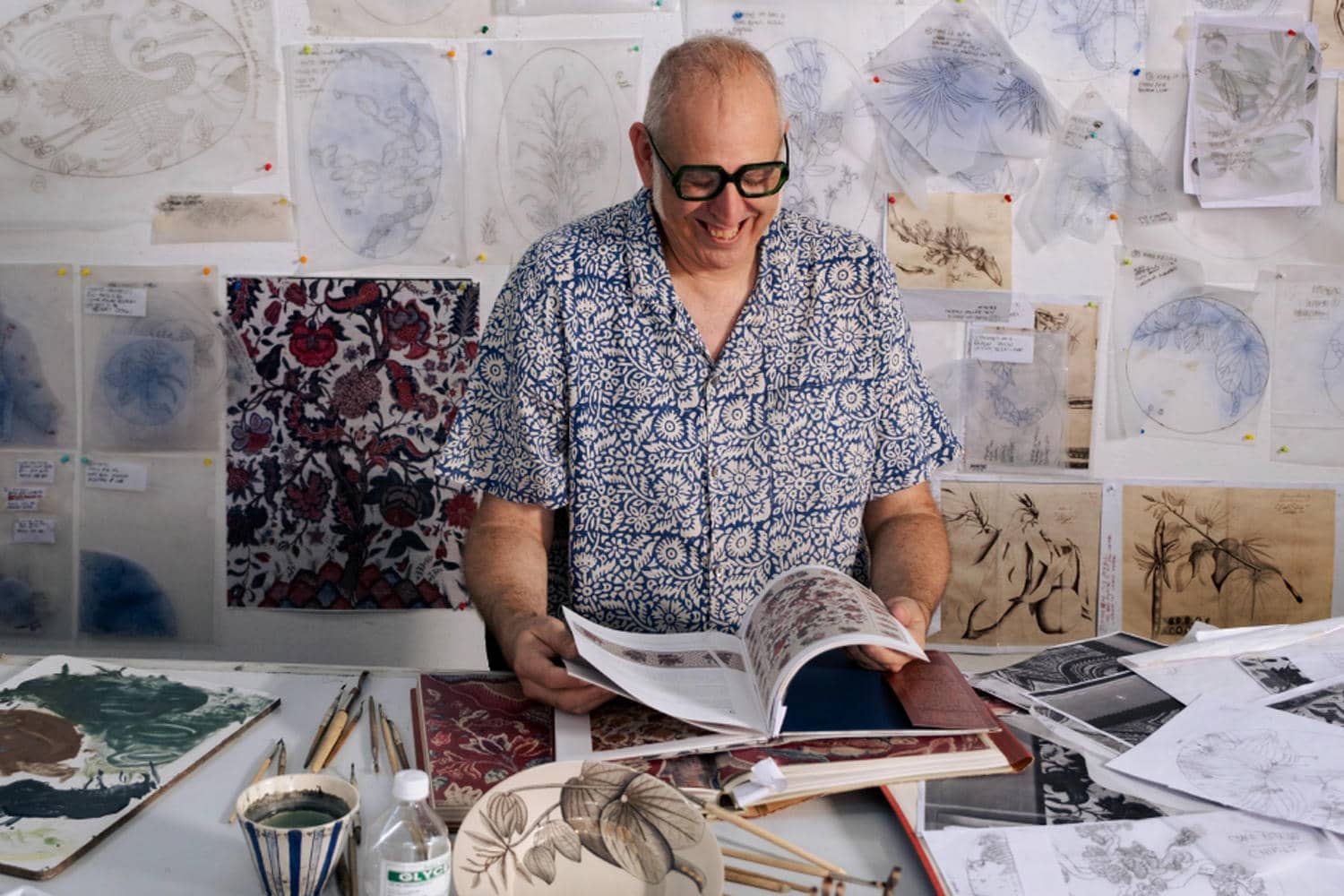
The ability to manipulate earth into refined tableware stems from the Golcha family’s deep engagement with mineralogy and particle technology. Khanoom functions as a collaborative laboratory where tradition is bridged with contemporary sensibilities. The partnership between Priyamvada Golcha and British designer Simon Marks was forged through a shared commitment to sustaining the livelihoods of local artisans while updating traditional skills for a global audience. Marks brought decades of experience working with craft communities across India and Indonesia, while Golcha provided the technical infrastructure and local cultural depth. The defining characteristic of Khanoom’s aesthetic is the application of traditional miniature painting onto the ceramic surface. The intricate motifs are executed by master artisans, each piece carefully hand-painted. After it is complete, every object is individually signed by the artisan, embedding authorship directly into the work and reinforcing the continuity of craft as a living, human practice.
For Nilaya Anthology, Khanoom’s collections draw from two historical moments that once positioned India at the centre of global exchange: chintz and the Hortus Malabaricus.
These collections were developed in close collaboration with Anthology’s creative team,
who shared original reference material and archival texts as a starting point for the design process. What followed was an elaborate exchange of research, interpretation and dialogue — where historical sources were not simply referenced, but actively re-read and reimagined collectively into contemporary tableware.
Originating along the Coromandel Coast in the sixteenth century, the word "chintz" itself is derived from the Hindi word cheent, meaning "spray" or "drop," referring to the method of hand-painting or block-printing patterns onto cotton. These textiles became a global phenomenon between 1600 and 1800, altering the interiors and wardrobes of Europe and
Asia. They were prized not just for their colour, but also for their botanical motifs and technical precision, serving as evidence of trade routes that carried aesthetic sensibilities across oceans.
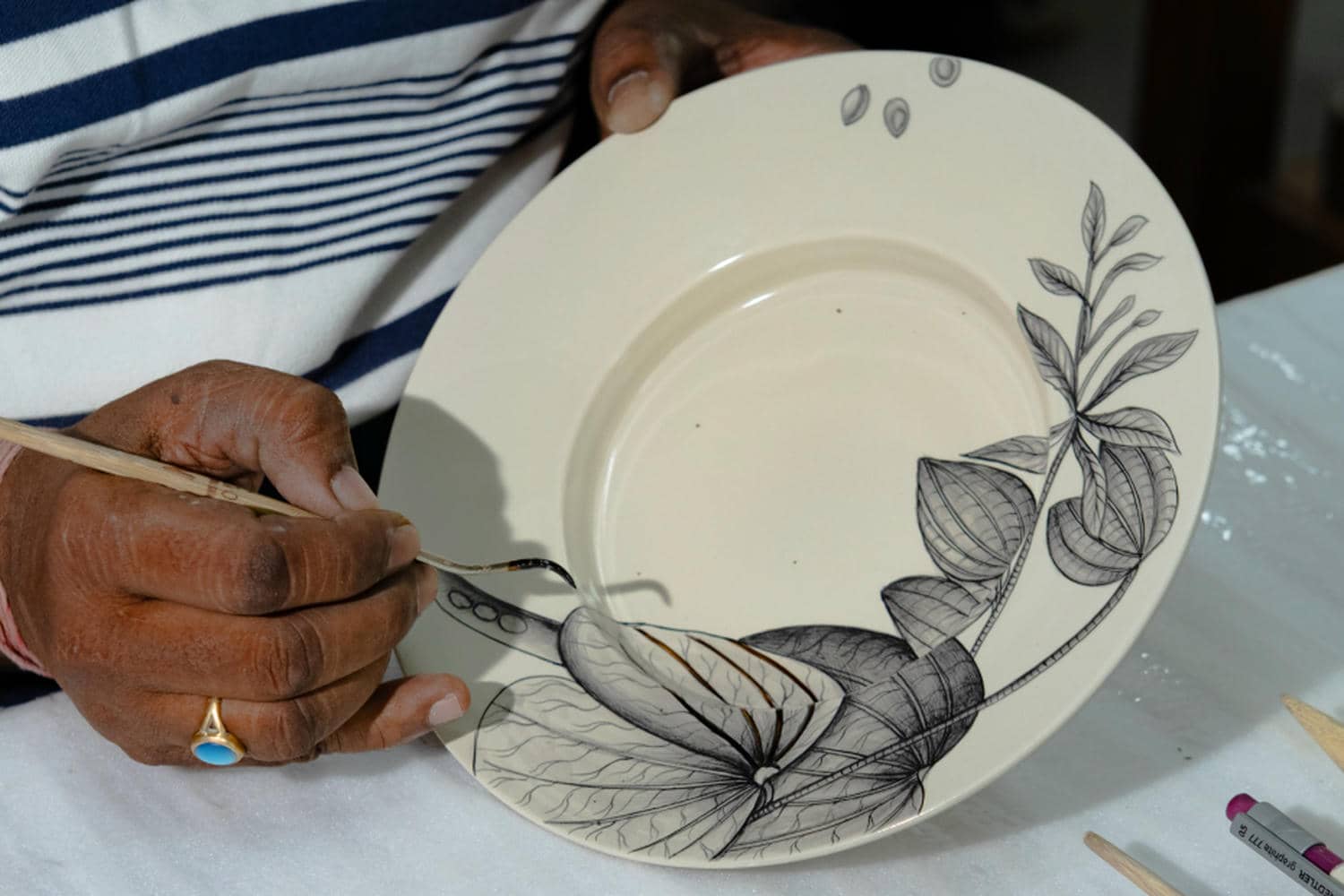
Anthology and Khanoom’s second reference point is the Hortus Malabaricus, a seventeenth-century botanical compendium chronicling the medicinal flora of India’s southwestern coast. Compiled over three decades and published in Amsterdam between 1678 and 1693, the twelve volumes were commissioned by Hendrik van Rheede, the Dutch Governor of Malabar. Within its pages, coastal plants are observed, named, and drawn — their identities translated across Malayalam, Sanskrit, Konkani, and Latin — bringing local medicinal practice into dialogue with European scholarship and botanical art.
FROM ARCHIVE TO TABLE, TABLE TO TIME
In this collaborative interpretation, the history of chintz moves from the textile archive to the ceramic plate. Motifs drawn from chintz reappear on plates and jugs, their indigo and madder palettes translated into ceramic glazes. Elements from the Hortus Malabaricus are distilled
into more subtle compositions, with plant forms unfolding across cups and bowls. The original texts spoke in several languages; here, the conversation shifts to pattern and placement.
The soft bleed of dye into fabric becomes a glaze detail along the rim of a plate. Mangoes
and pineapples, once traded across oceans, appear as painted forms that wrap around a vessel. Flowers emerge at the base of a cup and extend upward along its handle. The gesture
is deliberate, treating the table as a site where history can be revisited without spectacle.
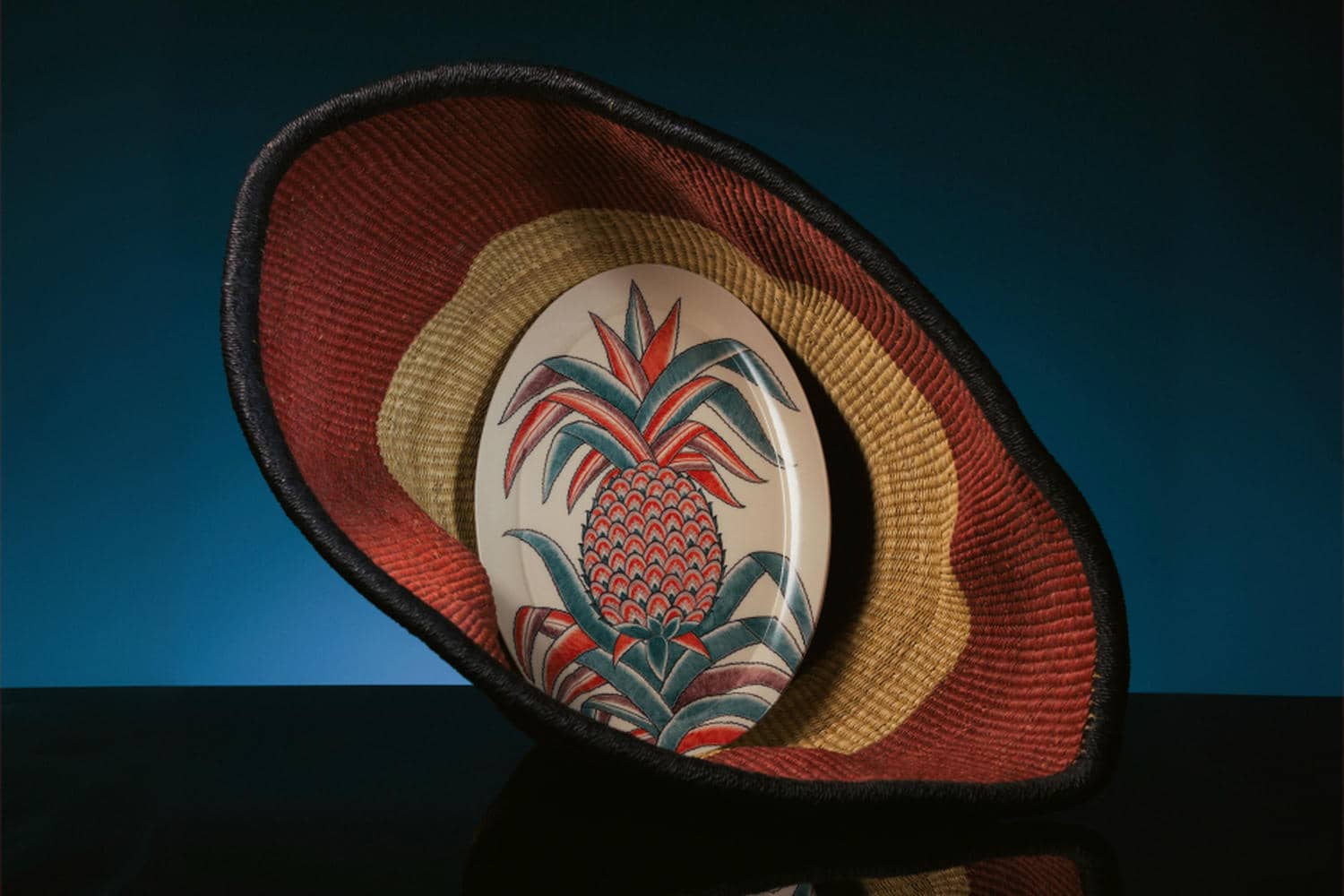
At Anthology, these vessels enter into conversation with materials from other geographies
and traditions. Rather than standing apart as historical reference, they participate in a larger narrative of wood, textile, metal, and stone. The table becomes a point of encounter where motifs once carried across oceans now extend their journeys onto the plate.
This story of clay is about continuity. If these pieces were discovered centuries from now, they would point to a practice grounded in memory and adaptation. At Khanoom, Priyamvada Golcha and Simon Marks work across material, technique, and narrative. The tableware reflects an ongoing collaboration between artisans, designers, and the material itself. Through the Chintz and Hortus Malabaricus collections, these objects carry forward histories of exchange while situating them in the present. Throughout this unique synthesis of science and art, Khanoom ensures that these records of how we live and gather will survive as reliably as the clay from which they are formed.
.webp)
-pichi.jpg)
.webp)
-pichi.jpg)
-pichi.jpg)
